Thursday, April 23, 2015

Early Boeing B-17 Raids II


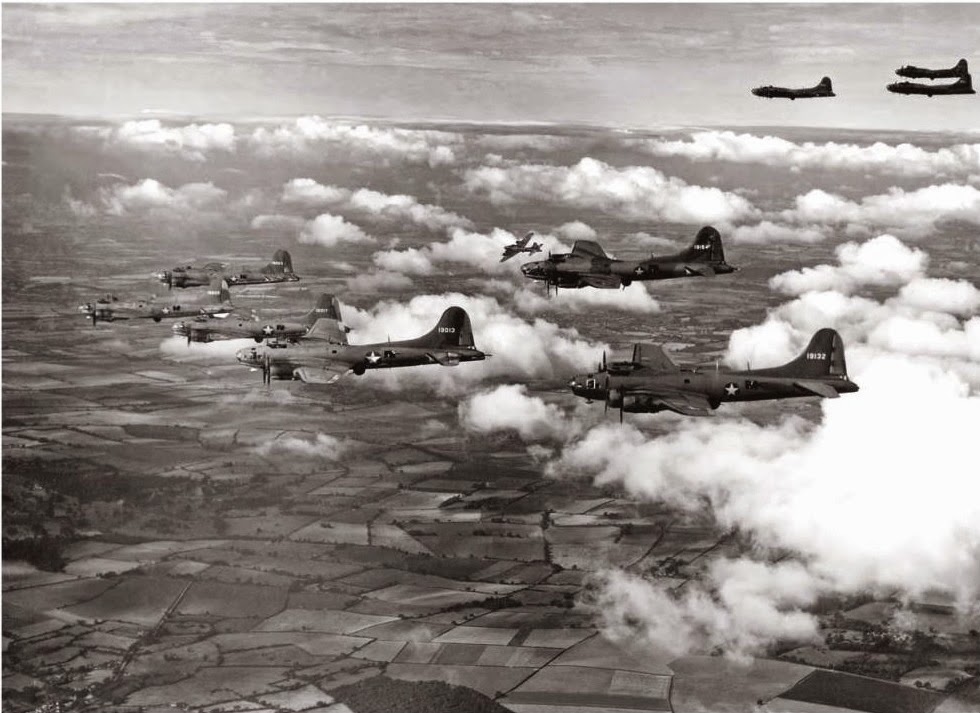
Later in August, the Eighth Air Force flew its first combat mission. Flying B-17Es, the 97th Bomb Group struck rail targets at Rouen, France, without loss. It was an auspicious beginning to what would become one of the longest attritional campaigns in U.S. history. Here, a squadron of B-17s forms up over England in preparation for a mission in 1942.

Meanwhile, the build-up gained steam until Operation Torch derailed everything. This was the invasion of Northwest Africa by a combined Anglo-American force. To carry out this operation, the Allies needed every available plane to support it. The Eighth was stripped of most of its fighter units, including the 1st, 31st, and 52nd groups, and lost some of its B-17 outfits as well. Spaatz and Eaker protested to no avail. Eventually, the Eighth lost 1,250 aircraft and 30,000 men. The bombing campaign came to a crashing halt. In December, the Eighth lost its talented commander, General Spaatz to the Mediterranean theater as well. Ira Eaker took his place It would not be until the following January that the fledglings in England would commence large-scale bombing operations against Nazi-held Europe.

As the Americans arrived in England, then had their build-up derailed by Torch, Bomber Command's night raids began to cause substantial damage.

The 1943 campaign would soon begin, and with it would come die first major contributions by the USAAF and its new fleet of heavy bombers. Exactly how that effort would be carried out in cooperation with the RAF dominated top-level discussions for the remainder of 1942, and during the Churchill-Roosevelt meeting at Casablanca in January 1943.

The RAF wanted the Americans to join the night bombing effort. Convert the Eighth Air Force to nocturnal operations and the Allies could have a force of thousands hitting Germany by moonlight before the end of 1943. The USAAF recoiled at the idea. The entire structure of its strategic force had been predicated on daylight precision bombing. All the Stateside training was geared toward this effort. Switching to night operations would require a wholesale reconstruction of the strategic bomber force. Hap Arnold, commander of the mid-1943. To the USAAF's materials command, hanging gas tanks under a fighter was an anathema that would ruin the aircraft's manoeuvrability in combat.

It would take time to sort out the fuel tank issue and the tactics. In the meantime, the B-I 7 and B-24 crews paid the price. The 1943 campaign would prove once and for all that if the bombers were to survive deep penetration raids into Germany, the Mighty Eighth had to have fighters that could go the distance with them. Wartime experience proved Billy Mitchell right: fighter and bomber had to work together just like combined operations in ground warfare. The cost to learn that lesson envisioned two decades before by America's most famous airpower theorist would be dreadfully high.

The USAAF, could not let that happen. Yet, Churchill had already nearly sold Roosevelt on the idea of doing this.

During the Casablanca conference in January, he cabled Eaker and told him it was up to him to save the daylight bombing campaign. Eaker had majored in journalism in college. He sat down and drafted a tight, one-page summary for Churchill that outlined all the reasons why converting the Eighth Air Force to night operations would be folly. The final sentence captured the Prime Minister's imagination.

"If the RAF continues bombing at night and we bomb by day, we shall bomb them round the clock and the devil shall do the rest."

Both leaders loved the idea of "round the clock bombing." The British would batter the Germans at night while from dawn to sunset the Americans would rule the skies. Twenty-four seven, Germany would receive no respite from the aerial bombardment.

After Casablanca, Eaker and one of his subordinates, General Hansell, sat down with two RAF counterparts and drafted a detailed plan for the 1943 air campaign. Called the Combined Bomber Offensive, the document set seventeen key target types to be attacked and destroyed during the year. The top three included: 1) the German aircraft industry, 2) ball bearings factories, and 3) Germany's oil refining infrastructure. Harris and Bomber Command would still make destruction of German morale its key objective for the year.

For both sides, 1943 would be a pivotal period in the strategic air war. Of course, as with most wartime ventures, nothing went as planned.

Lesson in terror


“It is probable that future war will be conducted by a special class, the air force, as it was by the armored knights of the Middle Ages.” BRIGADIER GENERAL WILLIAM “BILLY” MITCHELL WINGED DEFENSE, 1924

By 1918 there was a solid weight of opinion in the Allied countries calling for a bombing offensive against Germany, and frustration among political leaders at the military’s failure to deliver it. In April 1918, Britain created the world’s first independent air force, the Royal Air Force, to replace the army’s Royal Flying Corps and the navy’s Royal Naval Air Service. It was intended, among other things, to help give Britain more effective air defences, and to promote a strategic air offensive against Germany. The Independent Force of bombers was set up in June to carry out this offensive. Meanwhile the French commander-in-chief, Marshal Henri Pétain, called for a fleet of heavy bombers to “paralyze the economic life of Germany and its war industries by methodical and repeated action against principal industrial cities…”. In 1918 the Allies had the de Havilland-designed Airco D.H.9 and excellent Breguet Br.14 as day bombers and the Handley Page O/400 and Caproni biplanes and triplanes as night bombers. The Handley Page, although nothing like as big as the German R-planes, could carry a maximum bombload of 900kg (2,000lb), and formed the backbone of the Independent Force. Other heavy bombers, including the French Farman Goliath and the British Vickers Vimy, were under construction in 1918 but arrived too late to see service.

In the summer and autumn of 1918, formations of up to 40 Allied bombers flew raids deep into Germany. Predictably, bad weather and unreliable aircraft limited the effectiveness of the bomber offensive. But civilians in cities such as Frankfurt and Mannheim were taught the terror of air-raids that had already been experienced by inhabitants of Paris and London. Allied airmen were always under orders to aim for precise targets, such as factories or communications centres. But Allied political leaders were keen to affect civilian morale. The British Secretary of State for air, William Weir, told Hugh Trenchard, the commander of the Independent Force, not to be scrupulous in respect for civilian life: “If I were you,” he wrote, “I would not be too exacting as regards accuracy in bombing railway stations in the middle of towns. The German is susceptible to bloodiness, and I would not mind a few accidents due to inaccuracy.”

In fact, the air commanders were generally more sceptical about strategic bombing than the politicians. Trenchard knew he was supposed to use his force to bomb German cities and factories, but more often he directed it against tactical objectives such as airfields and communications centres behind the front. The same is true of US General Billy Mitchell. Both Trenchard and Mitchell later became advocates of strategic bombing, but they devoted themselves in the last months of the war to the tactical use of airpower.

The evidence of World War I was that, at current levels of technology, strategic bombing could neither seriously disrupt industrial production nor significantly weaken a population’s will to fight. Bombing was costly and inaccurate. Its chief positive effect lay in forcing the enemy to divert resources to air defence.

The building and operation of large bomber aircraft was nonetheless an important step in the progress of aviation. Bomber aircrews had accumulated extensive experience of long-distance flight and night flying, and the large aircraft they flew carrying bombs could, with relatively small modifications, carry passengers or freight instead. Strategic bombing in the Great War helped pave the way for the development of commercial aviation – as well as the devastation of Dresden, Tokyo, and Hiroshima.

ARTHUR HARRIS, (nicknamed ‘‘Bomber’’ Harris, 1892–1984)


Chief of the British Royal Air Force (RAF) Bomber Command from 1942 to 1945.
Born at Cheltenham in Gloucestershire, the son of an engineer-architect in the Indian civil service, Arthur Harris was educated at Gore Court, Sittingbourne, and Allhallows, Honiton. In 1914 Harris joined the first Rhodesian Regiment as a bugler and took part in the campaign against German South-West Africa. In 1915 he returned to Britain and was commissioned into the Royal Flying Corps. He participated in defensive night fighter operations against zeppelin raids and also served on the western front, where he earned enough victories to qualify as an air ace. After the war, he took a permanent commission in the RAF and was involved in air operations in northwest India, Iraq, and Palestine. In 1939 Harris was given command of No. 5 (Bomber) Group, which did valuable work against German shipping concentrations and airfields during the invasion threat in 1940. Later that year he became deputy chief of the Air Staff and in 1941 was appointed head of the RAF delegation to Washington, where he sought to speed up the delivery of aircraft and air supplies. In 1942 he was summoned back to Britain to become commander in chief of Bomber Command.

Under Harris, Bomber Command developed into a formidable weapon of war. His favored method of attack was the area bombing of German cities at night. He did not invent the policy—it was already in operation from 1941— but he pursued it with relentless zeal. He firmly believed that the destruction of German cities and the homes of the workers would bring the enemy to its knees and prevent a repetition of the bloody battles of attrition on the western front that he had witnessed during the previous war. While the United States Air Force concentrated on precision attacks during the day as part of a combined bomber offensive, Bomber Command unleashed a series of large-scale raids on such cities as Essen, Hamburg, and Berlin. The zenith of the area bombing campaign came at Dresden in February 1945, when the RAF started a massive firestorm that devastated the old city and killed between twenty-five and thirty-five thousand people.

Since the war the military and ethical justifications for Harris’s area bombing policy have been called into question. The critics argue that the results of the bombing were not worth the heavy cost in RAF aircrew lives, that the extensive resources poured into Bomber Command could have been put to better use, and that the deliberate targeting of German civilians was an unacceptable means of waging war. Harris’s defenders, however, contend that the bombing played a significant role in the Allied victory in Europe. Although the bombing did not prevent a sustained increase in German military production or fatally undermine civilian morale, the effects of the Anglo-American bombing offensive—and it is difficult to consider one in isolation from the other—were considerable. For example, a ceiling was placed on the growth of military output, and factories were diverted to producing items for home defense such as antiaircraft guns and ammunition, which deprived the German army of vital battlefield equipment. Many German troops were tied up in antiaircraft duties when they could have been more usefully employed on other fighting fronts, and German offensive airpower was restricted as the Luftwaffe was forced to defend the Reich against air attack. While the bombing of cities was undoubtedly a dreadful way to wage war, this was regarded at the time as little different from the policy of targeting civilians through blockade or siege in previous wars. The Allies were engaged in a war of survival against a brutal totalitarian regime, and civilian workers were at the heart of the enemy’s war potential. Certainly Harris, who had watched London burn during the Blitz, had little sympathy for the Germans: they had sown the wind and would reap the whirlwind.

At the end of the war Harris was embittered by the seeming reluctance of the British government to acknowledge the role of Bomber Command in the defeat of Germany. He retired from the RAF and went to live in South Africa. In the 1950s he returned to Britain and spent his latter years quietly in rural Oxfordshire, with occasional forays onto the public stage. He died in 1984. In 1992 a statue of Harris was unveiled by the Queen Mother in London. The mayors of Dresden and other cities that had been heavily bombed expressed their disapproval. The Bomber Command veterans regarded it as a long overdue tribute to a much maligned commander.

BIBLIOGRAPHY Harris, Sir Arthur. Bomber Offensive. London, 1947. Overy, R. J. ‘‘Harris, Sir Arthur Travers, First Baronet (1892– 1984).’’ In Oxford Dictionary of National Biography, edited by H. C. G. Matthew and Brian Harrison. Oxford, U.K., 2004. Probert, Henry. Bomber Harris: His Life and Times. London, 2001.